Belief, record and portrayal
Santa Muerte beliefs and history: what is documented, what is disputed
Beginners often meet three different kinds of statement about La Santa Muerte and cannot tell them apart. Marisol Vega's introduction separates devotional belief from documented history and disputed origin stories.
A useful distinction
Three kinds of question
When people talk about Santa Muerte, they are usually answering one of three different questions without saying which. What do devotees believe and practise? What does the historical record actually document? And what stories circulate about origins, some of them disputed?
The book’s introduction treats those as separate questions. Devotional beliefs are presented as beliefs rather than as historical findings. Documented history is distinguished from origin stories that remain disputed. Keeping the categories apart lets a beginner learn without having to decide in advance what to accept.
- Devotional belief
- What practitioners hold, pray and hope for. It is described as belief, not presented as a verified account of events.
- Documented history
- What the historical record supports. The book separates this from stories that cannot be settled by evidence.
- Disputed origins
- Narratives about how the devotion began that remain contested. The introduction names them as disputed rather than resolving them.
Learning without pressure
Why the distinction matters for a beginner
A beginner who cannot tell belief from history is easy to mislead in either direction. Treating every story as fact turns devotion into something it is not. Treating the whole practice as superstition dismisses the people who keep it.
The book’s approach is more patient. You are invited to consider what you seek, what you can consistently give, and how you might respond to disagreement or an unanswered request. Those questions do not depend on settling a historical argument first.
Stigma
Portrayals that reduce devotion to criminality
The book challenges portrayals that reduce the devotion to criminality. That challenge is not a denial that harmful representations exist in popular culture; it is a refusal to treat them as the whole story.
Alongside that, the introduction recognises that public shrines, family traditions and private altars need not follow identical customs. A practice kept quietly at home and a practice shared at a public shrine can both be sincere, and neither is the standard against which the other should be measured.
Understanding, not rules
Robes, symbols and colours
Robes, symbols and colours become subjects for understanding in the book, not reasons to assume that every devotee observes one universal rule. A colour or emblem that carries meaning in one household may be understood differently elsewhere.
For a beginner, that is freeing. You can learn what a symbol is associated with without being told that a mistake in arrangement invalidates the practice. The emphasis stays on attention and care rather than exactness.
If you are arranging a first image or altar, the practical guidance matters more than the symbolism at the start: a stable surface, a clean glass of water, a flower and a candle used safely.
Reader questions
Questions about belief and history
How does the book treat Santa Muerte origin stories?
The introduction distinguishes devotional beliefs from documented history and disputed origin stories. It does not present contested narratives as settled fact, and it separates what devotees believe from what the historical record supports.
Why does the book challenge criminal portrayals?
Because portrayals that reduce the devotion to criminality leave no room for ordinary practitioners. The book challenges that reduction while recognising that public shrines, family traditions and private altars need not follow identical customs.
Do all devotees follow the same rules about colours and symbols?
No. The book treats robes, symbols and colours as subjects for understanding rather than evidence of one universal rule. Customs vary between households and communities, and a beginner is not required to assume a single standard.
Do I have to accept every belief to begin?
The book invites you to learn before deciding. It treats proceeding, waiting and learning privately as legitimate choices, and it presents devotion as a relationship of care and reciprocity rather than a set of claims you must affirm immediately.
Keep reading
Other beginner guides
- Your first Santa Muerte prayerThe five-part structure the book uses: greeting, thanks, request, an optional promise, and farewell.
- An altar for small spacesModest, portable and stored arrangements for apartments, shared homes and privacy-sensitive households.
- Offerings on a budgetWater, flowers and food considered for meaning, cost, upkeep and household practicalities.
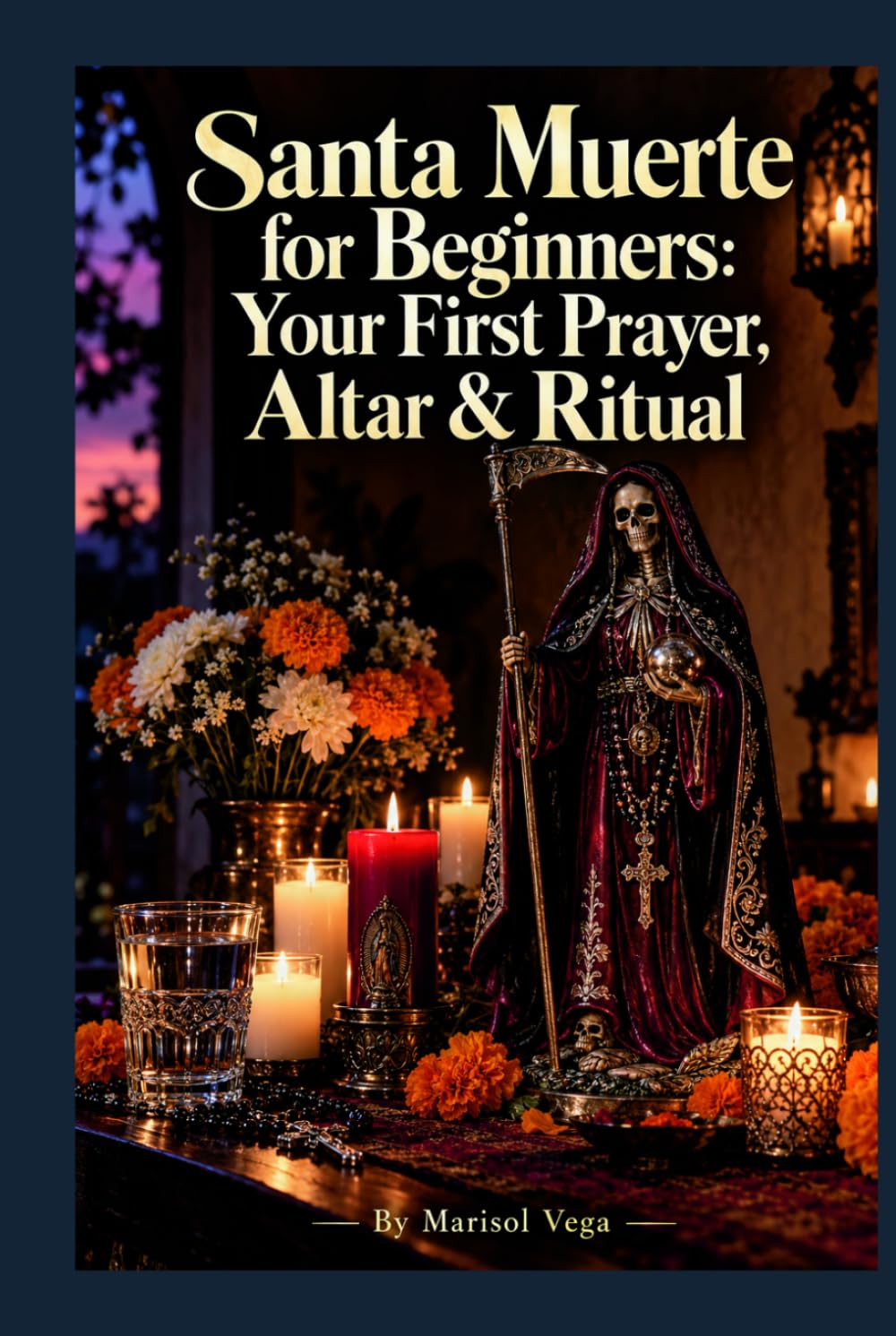
Start where you are
Santa Muerte for Beginners
Your First Prayer, Altar & Ritual
by Marisol Vega
If you want a grounded, unhurried place to begin, the book starts with your questions rather than a promise you cannot keep.
Purchase and delivery happen on Amazon. This site does not take orders or payments.